
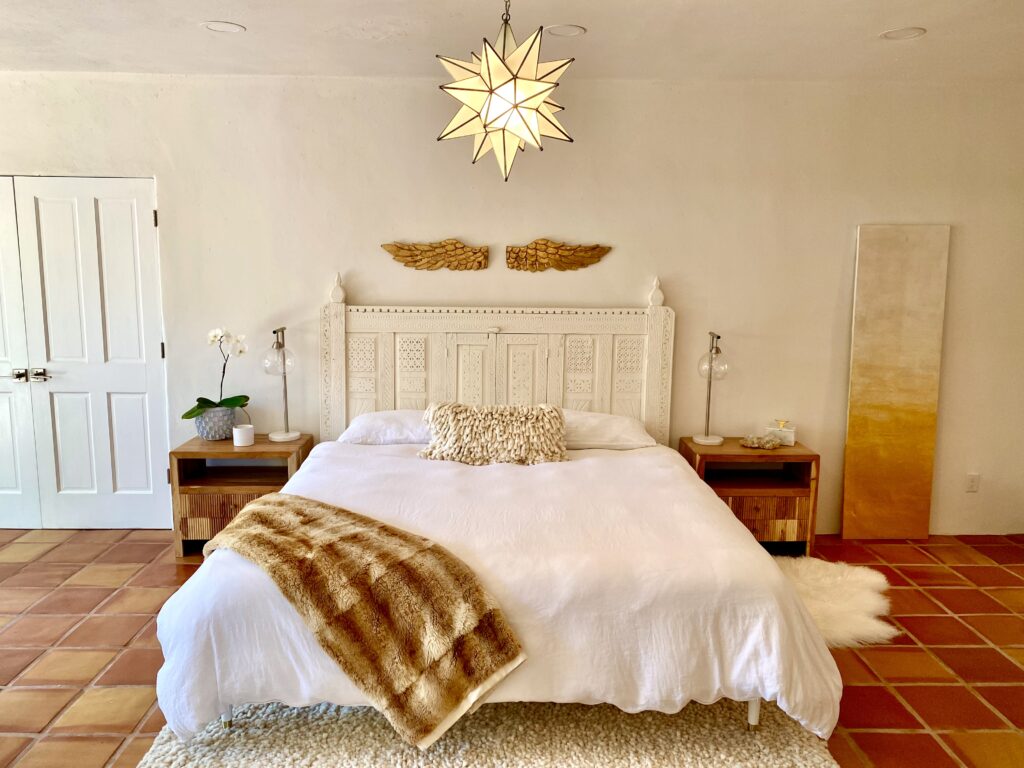
ARTICLE: Originally published in homes & gardens Magazine.
How we arrange the layout of furnishings and decor within our bedroom curates a visceral experience. There’s a narrative at play when the sensorial elements of our space come together, which influences our potential for relaxation, happiness, romance or sleep.
What we see, smell, touch and hear infuses and informs so much of how we think, feel and behave. How we experience those first moments in our bedroom offers us an invitation, opening the doorway of possibility for how we feel and the moments which follow.
We want to make certain our bedroom invites more of what we want in this room of love, romance, rest and rejuvenation.
The Duality of Design:
When thinking about the bedroom, consider the sensorial, or physical, experience in conjunction with the emotional and energetic experience.
We experience our bedroom on a sensorial level and those physical attributes which we refer to as “interior design” or our aesthetic expression impact how we experience the room on an emotional and energetic level.
We want to curate the room with design elements which encourage how we want to feel in unison with the outcomes we want to nurture. Those design elements follow a thread of intention, marrying how we want to feel with what we want to create more of in our own life.
When curating your bedroom to match how you want to feel with what you want to nurture and create, ask yourself:
- Does my bedroom feel like a reflection of my love life and my self love?
- Does my bedroom feel relaxing and encourage sleep?
- How do I experience my bedroom as I step into the room?
- How do I experience my bedroom when I view it from sitting on my side of the bed?
- How do I want to experience my bedroom?
- How might my bedroom encourage my deeper desires and dreams?
How we want to feel and what we want to support, encourage and experience determines how we curate our bedroom…and that need not require purchasing new furnishings.
Our Bed:
Our bed defines the function of the bedroom, without it, we’d have no bedroom. It’s also where we spend about ⅓ of our life! If we do not enjoy our bed, we likely do not enjoy restful sleep. Without a good night’s sleep everything becomes more challenging, including romance or happiness.
The bed…
- Influences the feel of the room
- Informs much about our peace of mind, values & self love
- Speaks to the circumstances of our love life & relationship with our self
- Reflects how we tend to each other, our self, our needs and desires
Placement of the bed:
- Place the bed on one of the two walls opposing the door, but not behind the door, if possible
- Ideally the bed is placed on a wall opposite the door, yet not in direct alignment with the door
- OR the bed is on a wall perpendicular to the door, (so the head of the bed is visible from the doorway and not behind the doorway)
- When the head of the bed is in clear view from the door, we cue the brain, “I’m here for sleep, love or dreams”.
- A room arranged with the head of the bed in view from the doorway feels bigger and more visually pleasing.
- This isn’t always possible, so don’t be troubled if your scenario isn’t ideal. That’s the beauty of design and the mind, creative options always exist!
- Place the bed in the center of the wall and not up against a corner wall (I explain why shortly)
Placement and Our Primal Brain:
I’m good about following rules, as long as the “why?” makes sense and resonates. So let’s take a deeper look at why placement is so important.
We experience our space on four levels: primal, universal, personal and energetic/spiritual. When considering how our space communicates with us on a primal level, we enter the domain of our subconscious mind.
It’s important to understand that the subconscious mind synthesises its environment within a fraction of a second and within that second we experience the effects of the space. Our mind quickly determines,
Am I safe?
Do I belong?
How do I behave?
Am I comfortable?
Do I enjoy this environment?
Imagine your ancestors thousands of years ago. Let’s presume they lived in a cave in the time of Sabre-toothed tigers. Where might you imagine they orient their sleep area? As far away from the cave opening as possible, right?
Our first consideration for sleep, as with our primal ancestors, is security.
- On a core fundamental level, our bedroom must offer us a place of safety and security, otherwise we cannot truly rest.
- Over time, a lack of feeling secure places an enormous burden on our physical, mental and emotional well-being.
- So in consideration of the bedroom, safety and security are paramount.
We want our primal mind to feel as much ease as possible, so deep rest may occur. This means we want to visually see anything coming through the doorway and have as much time as possible to react or defend ourself if need be.
Why don’t we want our bed positioned directly in front of the door?
When we align the center of our bed with the center of the door, we are more vulnerable and exposed to whatever comes through the door…think cave and tiger. We cannot see who or what might be coming through the door if our feet are in the way!
Once we’ve addressed the primal mind’s need for security, we want to make sure we’re creating a calming environment for rest and deep sleep.
Doors direct traffic to and from a space, there’s an energetic exchange underway through our doorways, opening a channel for people, objects and energy to flow.
When we sleep in direct opposition to a door, the apparent energetic flow moves toward the person trying to sleep. The door is literally front and center, perpetuating an unconscious expectation for something to be coming or going through our doorway. That silent anticipation becomes more subconsciously pronounced, impacting how well we rest or follow our intimate needs in privacy.
Make sure the bed is accessible from all sides:
Allow ample space on each side of the bed for ease of movement and access.
The more ease we create for ourselves getting in and out of bed, the more ease we feel as we drift to sleep or begin a new day. Those moments upon waking or sleeping hold enormous value, as they literally infuse and inform the moments which follow, impacting how we think, feel and experience our life.
Our home is rich with metaphor and we benefit when we take those metaphors literally within our home, in both sensorial and experiential terms.
When we feel pushed up against a wall, it doesn’t feel good. The same is true with the placement of our bed (*except for children, see below).
When we’re in a relationship or desiring relationship, we want equality for each individual. If the bed is pushed up against a wall, one person must work harder to get into and out of bed. If we desire a relationship and our bed is pushed into a corner, we’re not making space for someone to comfortably enter our life…or bedroom!
Interestingly, a bed pushed into a corner often accompanies certain dynamics within the relationship OR is a product of certain dynamics in a relationship. It’s amazing how our subconscious curates environments which mirror its own!
The seemingly mundane design elements of our home relate to both how we experience our outer life and inner world. There’s a visceral connection between the two, which impacts what’s showing up on the outside and how we’re feeling on the inside.
*Children often feel comforted by their bed being placed in the corner of the room. Keep in mind, a child is not interested in a significant other, so having one nightstand or the bed accessible from only one side feels good and having the support of a wall creates an additional form of security and support.
Nightstands and Symmetry:
As far as design standards go, the eye likes odd numbers. If a bedroom has two beds, typically we use one nightstand. If a room has one bed, we use two nightstands. These scenarios are more visually appealing and offer a more naturally balanced and grounded feel.
If we share, intend or desire to share our bed with another, our nightstands invite space for the other to join us under the sheets.
We want to make sure the nightstand real estate offers a similar experience for each person, allowing the bedroom to support each person individually, while also supporting their union.
Our nightstands hold this representation of balance, support and equality.
*When we place a second nightstand beside the bed, we’re calling in another person or we’re providing for another person. If a person intends to stay single with little interest in accommodating a relationship, there’s diminished need for an additional nightstand.
Mirrors in the Bedroom:
I love mirrors, yet I rarely place them in the bedroom and never opposite the bed. For the same reasons we discussed not wanting our bed facing a door, we do not want our bed facing a mirror.
Mirrors multiply, mirrors move energy and mirrors act as windows, which, in many situations is fabulous, just not in the intimate sleep chamber of our bedroom.
Mirrors multiply. We don’t want to multiply the number of people in a bedroom. Our bedroom is meant to cradle one or two people. A mirror doubles the number of people in the room.
A mirror within view of the bed is akin to the visual representation of being watched as you sleep.
Mirrors mimic motion. Mirrors create too much activity for the calm stillness required for restful sleep.
*NEVER ever place mirrors opposite each other anywhere in your home, unless you want to experience the madness of dueling infinities or the thrill of being a Rockette!
Art in the Bedroom:
Every item in our bedroom whispers a message to our subconscious, so we want all of the items in our bedroom, especially the art, to communicate our intentions around love, self love, restfulness and our deeper dreams.
Our art holds both a sacred and alchemical potential, acting as the crown jewels of our bedroom, summoning our intentions to life.
The last things we see upon falling asleep and the first things we see upon waking, act as a catalyst for our subconscious thoughts. We want to make certain those first objects we experience upon drifting or waking conjure thoughts of inspiration, empowerment and love, for they are the nourishment which sustain our spirit throughout our day and night.
Primary real estate for art in the bedroom:
- On the wall opposite our sleep space
- On the wall opposite the bedroom door
- On or by our nightstand
Infuse your bedroom with those visual messages supporting love, rest and your deeper dreams and desires.
Clutter in the Bedroom:
On a subconscious level, we hold an ongoing awareness of every item within our bedroom. Whether it’s an over-packed wardrobe, a picture hung askew, or a box of love letters from way back when, on some level, we’re feeling ALL of it whenever we’re in the room.
Remember, every item in our bedroom communicates a message to our subconscious mind. The same holds true for the space under our bed. Out of sight is NOT out of mind when it comes to under our bed.
The items under our bed are communicating with us, whispering a themed message related to those items.
When we’re working toward creating an optimal environment for sleep or love or both, we want all of the space around our bed supportive of our efforts.
Additionally, items placed on the floor create stagnation. So if you’re feeling a lack of enthusiasm or find yourself procrastinating, getting items off the floor will definitely help.
If we want to place an item under the bed as a symbolic gesture for our self love, love life or dreams, by all means. Otherwise, what we place under our bed is making a statement fueled by stagnation.
Workspace in the Bedroom:
If you must keep your office or workspace in your bedroom, do your best to orient it out of clear view from where you sit in bed.
What we see opposite our side of the bed holds enormous value for accessing our subconscious mind. When our workspace is aligned with our sleep space, expect to think, sleep and dream work.
Also, if possible, orient your workspace so it’s not in clear sight from the doorway as you step into the room. We want the first thing we see in the room to be associated with rest, sleep and love and definitely not work.
When your home requires you work from your bedroom:
- Orient your workspace out of clear view from where you sit or lie in bed
- Orient your workspace so it’s out of sight from the doorway as you step into your bedroom
- Do not place your desk opposite your bed…if you must…
- Aesthetically conceal your work space from your sleep space with curtains or a tapestry or a screen
- Place a beneficial intention around the environment where you work, offering a mental, emotional and psychic shield protecting and supporting your work experience. Do this exercise for your bedroom as well, setting an intention supporting your sleep and love life.
- Every act is a symbolic gesture and when we infuse our physical environment and belongings with the intentions for our life, we magnify their collective potential exponentially.
Closing:
When I work with clients, the first thing I want to know is, what do they want…what’s working & what’s definitely NOT working. We want the desires, values and intentions for our life to play a primary role in how we curate, design or arrange our bedroom.
My design ethos connects all design elements to those core desires and intentions of my client. It’s less about how it looks and more about how it feels, how it functions and what it inspires to life within them.
Our bedroom reflects our ideals around love, self love and rejuvenation, while also holding space for our dreams.
Every item we place in the bedroom must support the function of the room, our desired experience for the room and our aspirations for our future.
When we think about our bedroom we want to ask, what am I willing to invite into my love life, what will enhance feelings of self love and what ingredients do I want into my dreams?
Every act is a symbolic gesture and every item we place in our bedroom holds a conscious or subconscious intention.
Every item in our room should support those intentions.
The more our bedroom supports ease, the more ease we feel.
The more our bedroom supports privacy, the more comfortable and free we feel for intimacy and vulnerability.
The more our bedroom supports rest, the more deeply we’re able to sleep and feel rejuvenated each morning.
____________________________________
Kimberly Garner is the founder of the School of Integrative Design™. She is a design curator, writer and philosopher, who pioneers the field of NeuroSpatial Linguistics. Her work has led her to the deep conviction that home plays an essential role in optimal wellbeing and personal fulfillment.
.